
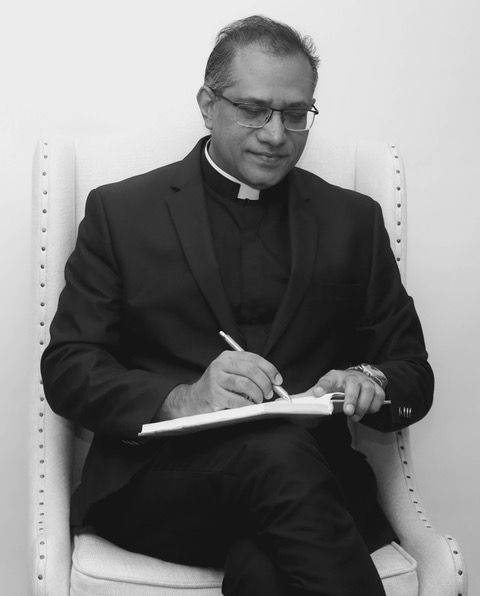
I was born and brought up in Trivandrum, the historic city nestled in the southern reaches of Kerala, India. From the earliest years of my childhood, the biblical figures and the larger-than-life heroes of Indian Hindu mythology unfolded before me vast landscapes of wonder, courage, sacrifice, and mystery. Stories became the windows through which I gazed into unseen worlds. I read whatever I could lay my hands on. Books became my silent companions, carrying me beyond the narrow horizons of my surroundings into realms where imagination knew no boundaries. I still remember, as an eleven-year-old boy, the night I wept bitterly after journeying through the life of Jean Valjean, the unforgettable hero of the Malayalam translation of Les Misérables, Victor Hugo’s monumental masterpiece. It was perhaps the first time I discovered that literature possessed the mysterious power not merely to entertain, but to awaken compassion and transform the soul.
Yet I was never a hurried reader. Often, while turning the pages, I would suddenly pause, allowing the words to sink quietly into the depths of my being. I would linger over the events, contemplate the emotions, and search for the hidden meanings that lay beneath the surface of what I had read. Thus, a book that others might finish in a single day would remain with me for days. Another habit that profoundly shaped my journey as a reader was that I was drawn not merely to the central ideas or principal themes of a book, but to the descriptions, explanations, and delicate details woven almost invisibly between the lines. I found delight in the way an author painted a landscape, unveiled the depths of a character, or breathed extraordinary life into the most ordinary of moments. Looking back today, I realize that these two habits – slow, contemplative reading and an attentive appreciation of the hidden richness of language quietly nourished the roots of my imagination. Over the years, they became the unseen foundation upon which my own writing gradually took shape.
My father, a former military officer, was my first storyteller. His narratives were not simple retellings; they were vibrant worlds filled with color, emotion, and wonder. He possessed the rare gift of transforming familiar stories into unforgettable experiences through his dramatic expressions and imaginative exaggerations. I still remember the awe with which I listened to him narrate the story of Moses from the Bible and the heroic journey of Karna from the Mahabharata. Under his voice, these ancient figures seemed to rise from the pages of history and stand before me, larger than life, carrying the weight of their struggles, victories, and destinies.
The limited resources available in my home, school, and village revealed their limitations when I entered the seminary for my priestly formation. There, I discovered an ocean of books, English and Malayalam periodicals, short stories, autobiographies, poetries and novels. The works of celebrated Malayalam writers such as Madhavi Kutty, M. T. Vasudevan Nair, and Vaikom Muhammad Basheer greatly enriched my reading and profoundly influenced the literary aspirations of readers of my generation. Their writings opened before me the richness of Malayalam literature, revealing the beauty of ordinary lives, the depth of human emotions, and the artistry hidden in everyday language.
It was my desire to explore this boundless world of literature that led me to pursue a master’s degree in English literature. Though I appreciated the unparalleled writings and profound characterization of Shakespeare, it was the writings of the Russian authors, Fyodor Dostoyevsky and Leo Tolstoy, that gradually transformed my literary vision. Their penetrating exploration of the human psyche, philosophical reflections on life, portrayal of spiritual crises and personal struggles, and, above all, their profound engagement with the person of Jesus Christ gave me an entirely new perspective to read and understand Bible. Although both boldly criticized the institutional Church and exposed the moral failures of society, they approached Christianity in profoundly different ways and ultimately arrived at different conclusions about Christ, faith, and salvation. Yet for both, the person of Jesus remained the supreme inspiration and guiding force behind their writings.
At one point during my seminary years, I had the opportunity to read The Prophet, one of the most celebrated works of Khalil Gibran, a Lebanese, U.S writer. More than the profound wisdom contained in its pages, I was captivated by his unique style of writing – his poetic prose, mystical language, vivid imagery, and rich symbolism. Every sentence seemed to breathe like poetry while carrying the depth of philosophy and the tenderness of prayer. Although I cherish all his writings, it was Jesus the Son of Man, published in 1928, that greatly reshaped my understanding of humanity, priesthood, and society. Through the voices of ordinary men and women who encountered Jesus, Gibran revealed a deeply human yet profoundly divine Christ, inviting me to rediscover the Gospels with fresh eyes and a renewed heart. If readers discover even a faint echo of Gibran’s voice in the pages of At His Feet, I will consider it not an imitation, but a tribute to one of the writers who shaped my literary soul.
At His Feet is my fourth book and my first written in English. Its original Malayalam edition was published by Pranatha Books in 2022. My first book, Nashtapettavarude Sangeetham published in 2015, was a collection of reflections on the often-unnoticed figures of the Bible—those silent characters who stood in the shadows of great events, yet whose lives carried profound lessons for every generation. In 2017, I published my second book, Yogayum Dhyanavum Varum Talamurayude Vijayaretham of meditations with the hope of accompanying young adults on their journey towards purpose and success. I have always believed that meditation has the power to sharpen the mind, deepen one’s focus, and cultivate an inner serenity amidst the noise of life. Padangale Prenayicha Penkutti, my third book in Malayalam which is the original work of At His Feet is lifelong cherished dream fulfilled.
Thus, I continue my journey of priesthood, seeking to love humanity, pray for the world, and serve Christ through both my ministry and my writing. With every page I write, I aspire to transform ink into images, experiences into sentences, and stories into living realities that continue to breathe within the hearts of my readers.